AH-NFM-TECH-01 · Materials
Bronze, Brass and Copper
Recognition, surfaces, deterioration and responsible decision-making for the copper-alloy family.
Independent technical review is pending. Publication does not establish scientific approval.
What is it?
Copper is the parent of this material family. Bronze is principally an alloy of copper and tin, frequently with additions of lead, zinc, phosphorus or other elements adjusted by founders to suit casting behaviour, colour and working properties. Brass is principally an alloy of copper and zinc, again with secondary additions that materially affect appearance and corrosion behaviour. The everyday names are therefore imprecise: a nineteenth-century 'bronze' may contain enough zinc to behave, in conservation terms, more like a brass, and historic 'gunmetal', 'bell-metal' or 'statuary bronze' each describe distinct compositions with distinct surface tendencies.
Visual identification from colour, weight or sound is provisional at best. Surface treatments — applied patinas, lacquers, paint, gilding, plating — routinely disguise the underlying alloy, and the alloy itself may vary between cast sections of the same object. Confident identification, where it materially affects a decision, normally requires specialist examination and, occasionally, analysis. For most custodial purposes the family-level recognition set out here is sufficient; what matters more is reading the surface accurately and understanding what the object is doing in its setting.
Where you may encounter it
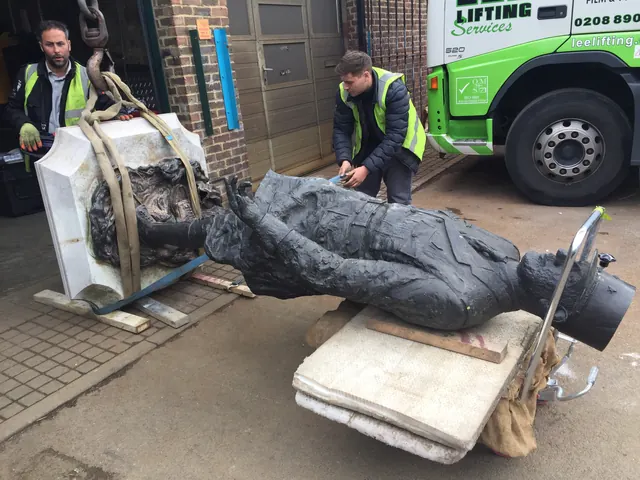
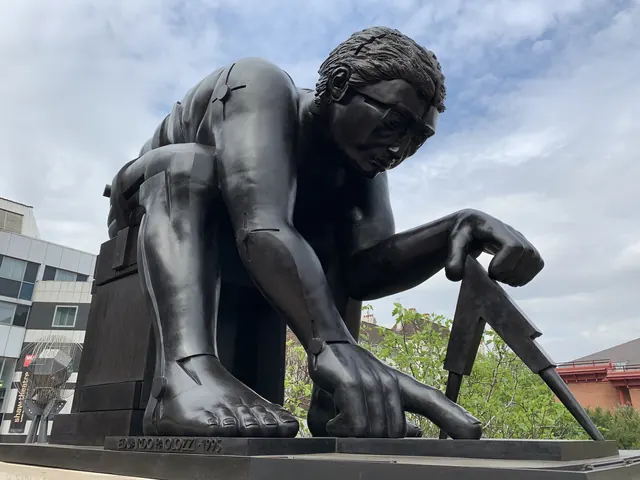
Bronze is encountered most often as cast work: free-standing sculpture, equestrian and portrait monuments, war memorials, relief panels, plaques and inscriptions, architectural doors, screens, gates and grilles, fountains and basins. Each typology carries its own conservation expectations — a war memorial inscription is read very differently from an architectural grille, even where the alloy is similar.
Brass is most often encountered in fittings rather than primary structure: door furniture, push plates, kicking plates, handrails and balustrade caps, ventilation grilles, ecclesiastical and civic interior fittings, memorial tablets and inscriptions. Surfaces are commonly polished and lacquered, or deliberately darkened; the maintenance regime expected of brass fittings has historically been more interventionist than that expected of external sculpture, which itself creates conservation tensions when an object moves from one regime to another.
Copper on a building is normally performing a weatherproofing role: roof coverings, domes, cupolas, spires, canopies, flashings, gutters, hoppers, rainwater pipes and ornamental detailing such as finials and cresting. Its conservation cannot be separated from the assembly it forms part of — the timber decking, the fixings, the joint detailing, the adjacent stonework and the water path through the building.
Why the surface may matter
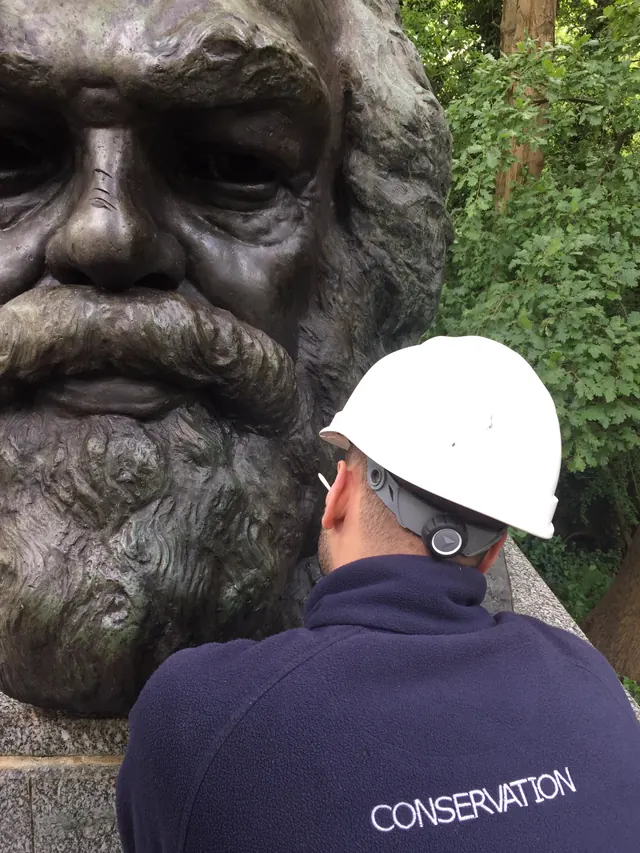
Copper alloys exposed to the atmosphere develop a layered surface chemistry that conservation literature commonly describes as a stratigraphy: an inner, generally stable cuprite layer, overlaid in time by basic copper sulphates and carbonates — brochantite, antlerite and related compounds — whose proportions reflect the pollution history, orientation and rainfall pattern of the site. These layers are not a single 'patina' but a composite record of the object's life in a particular environment. They are, in conservation terms, evidence.
Historic bronzes were rarely intended to weather bare. They commonly left the foundry artificially patinated by chemical or heat treatment and were protected by a wax or oil coating that was expected to be renewed at intervals. Victorian and Edwardian foundry practice produced a range of intended colours — warm browns, deep blacks, near-greens — chosen by sculptor and founder together. Where such an applied surface survives, even in part, it is part of the work and not a layer to be removed in pursuit of a uniform appearance.
Brass surfaces present the opposite difficulty. Polished-and-lacquered, darkened, plated or painted surfaces are each plausible historic intentions, and the same fitting may have moved through several of these regimes. Bright brass is not a default state; it is an active choice with maintenance consequences. Copper roofing surfaces, finally, must be considered alongside their drainage: a green roof that is performing well is not automatically a candidate for intervention, and run-off staining on adjacent stone is a symptom to be read, not a defect to be erased.
How copper alloys deteriorate
Corrosion of copper alloys in the external environment is normally slow and self-limiting, which is one reason the family has been favoured for monumental work. That general stability conceals a number of specific mechanisms which are not slow, and which custodians should learn to recognise.
Moisture retention is the principal driver of localised deterioration. Wherever rainwater is held against the surface — in the folds of drapery, in undercuts, in the joint between a sculpture and its plinth, behind a fixing washer, inside a hollow casting that has lost its drainage — corrosion accelerates and the surface chemistry diverges from the surrounding metal. Chloride contamination, whether from coastal aerosol, de-icing salts or earlier treatments, can initiate active corrosion that no longer self-limits; the characteristic light, powdery, bright-green eruptions of so-called 'bronze disease' are a visible expression of this process and warrant prompt specialist assessment. Sulphate-rich urban atmospheres, although much less aggressive than they were in the twentieth century, continue to influence patina composition and to produce the green run-off familiar on city monuments.
Galvanic relationships introduce a separate class of risk. Where a copper-alloy element is fixed to, or drains across, a less noble metal — most commonly iron or steel armatures, dowels, cramps, brackets or adjacent ferrous fittings — the ferrous component will preferentially corrode in the presence of moisture, producing expansive iron oxides that stain, stress and eventually split the host material. Rust-coloured staining emerging from within a bronze, or from the joint between a bronze and its stone setting, should always be read as a structural warning rather than a cosmetic blemish.
Casting defects and historic repairs form a third strand. Porosity, cold shuts, plugged blowholes and inserted repair patches were normal parts of foundry practice and are not in themselves defects of significance; but they create preferential paths for moisture, and they may become visible as differential weathering, local staining or surface lifting decades after the object was made. Coatings deteriorate on their own timescale: waxes thin, polymerise and harden; lacquers craze, lift, yellow and trap moisture beneath; over-coated waxes build into discoloured layers that obscure detail and complicate any later assessment.
What to notice and record
- Overall colour and surface uniformity, read against orientation and shelter — patchiness on a weathered bronze may represent normal differential exposure, surviving coating, earlier intervention, or active deterioration, and requires interpretation in context.
- Bright, light-green powder or pale eruptions, particularly in sheltered hollows, undercuts and drapery folds — may indicate active chloride-driven corrosion and requires specialist assessment rather than removal.
- Coherent darker greens, browns and blacks across exposed faces — commonly represent stable weathering or surviving foundry patina and should not be disturbed on appearance alone.
- Green run-off staining on stone plinths, walls or paving below copper-alloy elements — typically a normal product of weathering, but its pattern, intensity and change over time should be recorded as part of the conservation record.
- Rust-coloured staining or weeping from within a casting, around a fixing, or at the metal-to-stone interface — must be assessed as a possible indicator of internal ferrous armature or fixing corrosion.
- Cracks, distortion, loose elements, opened joints or movement against fixings — may suggest armature failure, casting defect propagation, freeze-thaw activity within a water trap, or impact damage; the cause must be understood before any repair is contemplated.
- Coating evidence: glossy islands, dull patches, crazed films, sticky residues, drip lines and tidemarks — record these as surface history, not as defects to be cleaned away.
- Previous repairs, patches, fills, inserted plugs, recut inscriptions or areas affected by earlier polishing — locate, photograph and date insofar as the record permits.
Conservation dilemmas
The most common request a custodian will receive in relation to a bronze monument is to 'restore' it — and behind that word sits a real conservation dilemma. Public expectation, often shaped by polished interior brasses or by recently recast or recoated work elsewhere, may run directly counter to the evidence held in the object's own surface. A coherent weathered patina that the conservation literature reads as a stable historic surface may be read by a passing observer as neglect; a uniformly dark, freshly waxed appearance may be read as 'cared for' when in fact it represents a substantial intervention into a surface that no longer exists.
Repatination — the application of chemical or thermal treatment to produce a new artificial colour over an existing surface — is the most consequential of these decisions. It is not, in any straightforward sense, reversible. It alters the visual and material evidence of the object, it commits the custodian to an ongoing maintenance regime to sustain the new appearance, and it sets a precedent for the asset and for comparable works nearby. The same is true, in lesser degree, of comprehensive cleaning and recoating campaigns. Each may be justified in a particular case; none should be approved on the basis of appearance alone.
The distinction between conservation and restoration is useful here. Conservation seeks to retain, stabilise and prolong the existing significant fabric, including its surface. Restoration seeks to return the object to a chosen earlier state, accepting the loss of intervening evidence. Both have legitimate places in heritage practice, but they answer different questions and require different justifications. Custodians and their advisors should be explicit about which they are doing, and why.
Polishing of historic brass and bronze sits in a related but distinct space. Routine polishing of interior brass fittings within an established maintenance tradition may be entirely appropriate; the same regime applied to an external memorial inscription, or to brass that has been deliberately darkened as part of an interior scheme, can be irreversibly damaging. The test is not the material but the surface intention and the maintenance culture the object has lived within.
Questions before approving work
- What is known, from documentary, photographic or material evidence, about the original or intended surface — and where the record is silent, how is that uncertainty being managed?
- What is the current condition evidence, including dated close-up photographs, written description and, where appropriate, mapped recording of surface zones?
- Is the surface assessed as stable, actively deteriorating, or uncertain — and what observation period or monitoring underpins that judgement?
- Have the fixings, internal armature, hidden cavities, drainage paths, plinth interfaces and adjacent stonework been considered alongside the visible metal surface?
- What is the conservation case for the proposed work — what problem is it solving, what evidence supports that problem, and what less interventive options have been considered and set aside?
- What test areas, samples or trial panels will be presented for review before any work is extended across the whole surface?
- How will the existing surface and the proposed treatment be documented, and how will that record be retained for future custodians?
- What maintenance, inspection and recoating regime will the proposed treatment commit the custodian to, and is that regime resourced?
- What permissions, consents or notifications are required — listed building, scheduled monument, ecclesiastical, public art, war memorial or other — and have they been secured?
- What evidence demonstrates that the proposed conservator or contractor has directly comparable experience of this asset type and surface condition?
What not to do
- Do not polish historic bronze or brass simply because it appears dull, patchy or uneven — appearance alone is not sufficient evidence for intervention.
- Do not remove green surface material without first establishing whether it represents stable weathering, surviving foundry patina, or active chloride-driven corrosion.
- Do not apply chemical, acid, abrasive or proprietary cleaning products to historic surfaces; even mild domestic preparations can be irreversibly damaging at this scale of significance.
- Do not apply wax, oil or lacquer over an existing surface without understanding what is already there, how the new coating will interact with it, and what maintenance commitment the new system implies.
- Do not repatinate or alter the colour of a historic surface without a documented significance-led case, sample panels, specialist input and any required approvals.
- Do not replace cast elements, plaques, inscriptions or sections of architectural copper without a full record of what is being lost, a compatibility assessment, and the relevant consents.
- Do not address rust staining or movement cosmetically; the cause normally lies within the assembly, and surface treatment without diagnosis will accelerate, not arrest, the underlying failure.
Maintenance and custodial responsibility
Most copper-alloy heritage assets need less intervention than they receive and more attention than they are given. A modest, sustained regime — periodic inspection, photographic recording, removal of vegetation and debris from water traps, attention to drainage at plinth level, and review of fixings and adjacent materials — will extend the life of the existing surface far more reliably than any episodic cleaning or recoating campaign.
Maintenance and significance are linked. A surface that has been allowed to develop and stabilise over decades carries evidential value that cannot be reinstated once removed; a maintenance regime that respects that surface is itself part of how the asset's significance is sustained. Conversely, deferred maintenance — blocked drainage, unaddressed fixing corrosion, neglected coatings allowed to fail catastrophically — typically forces more interventive work later, and narrows the conservation options available. The custodial task is long-term; decisions taken now should leave future custodians with at least as many options as are held today.
Technical references
- English Heritage / Historic England, Practical Building Conservation: Metals (2012) — primary authority for copper-alloy conservation in the historic environment, including patina, coatings and fixings.
- Historic England, Bronze Statuary — guidance on the recognition, condition assessment and care of external bronze monuments.
- Historic England, Metals in Conservation; Issues Common to all Metal Statuary — cross-material context for statuary conservation decisions.
- Canadian Conservation Institute, Caring for metal objects; Recognizing Active Corrosion — practical observational guidance, drawn on here for the description of active versus stable corrosion.
Need project-specific advice?
Arts Heritage is a conservation practice. For advice on a particular asset or proposal, contact Arts Heritage ↗.