Skip to content

Technical drafts · Copper alloys · outdoor sculpture

Intended readers: Conservation architects, metals conservators, collection and public-art managers

Unreviewed technical draft — not a published article

Written for professional readers with section-level citations; individual claims and survey interpretations still require verification. No named independent technical reviewer or owner approval exists yet. Search engines are instructed not to index this draft; actual exclusion is not verified. It must not be relied on as treatment advice. Interventions should be designed and carried out by suitably qualified conservators and specialists.

Open questions for the reviewer (3)
  • Reviewer to confirm whether any outdoor-bronze field indicators beyond those cited (e.g. pitting morphology) should be stated, and from which published source.
  • No source here gives quantitative wax re-application intervals; none are stated. Reviewer to advise whether a published maintenance-cycle source should be added.
  • Chemical identification of specific copper corrosion minerals is outside the cited sources and is deliberately not attempted.

Bronze sculpture surfaces: patina, corrosion and coatings — a differential reading

How to read the surface of an outdoor bronze before anyone touches it: separating intended artificial patina from natural weathering, distinguishing archaeological ‘bronze disease’ from outdoor green corrosion, recognising wax and coating residues, and identifying hidden internal risks such as trapped water, casting core and iron armatures. Written for professionals commissioning or assessing work; it gives no treatment recipes.

Scope and how to use this chapter

Editorial synthesis drawing on cited principles

This chapter supports observation and briefing. It separates what can be seen on site (observation), what that might mean (interpretation, usually with alternatives) and what would be needed to confirm it (evidence still required). Historic England frames repair as remedying the cause of defects on the basis of sufficient information, preceded by survey and investigation of the nature and condition of materials and the causes of decay. The same order applies here: describe and record first; diagnose only with evidence; specify only after a qualified conservator has assessed the object.

Sources: [1] Historic England

Intended surfaces: artificial patinas, finishes and lacquers

Cited source statements; survey interpretation requires review

CCI records that artificial patinas can be created on bronze; this source does not establish how commonly sculptures left the foundry with them. The Canadian Conservation Institute (CCI) stresses that metals can be artificially finished or patinated by a variety of techniques, that it is important to tell these original finishes apart from later surface layers, and that finishes, patinas and lacquers are often extremely thin and can be damaged by even small amounts of abrasion or chemical cleaning. Practical consequence for a survey: treat every coloured surface as potentially original until shown otherwise. Record colour, sheen, uniformity, and whether colour changes follow the modelling, water paths, drips or sheltered undersides; these patterns alone do not establish intention or cause. Do not commission trial cleaning to ‘see what is underneath’; that is itself an intervention and belongs inside a conservator’s method statement.

Sources: [2] Canadian Conservation Institute

Stable patina versus active corrosion

Cited source statements; survey interpretation requires review

CCI describes stable patinas on copper alloys, natural or artificial, as generally coherent, adherent and smooth, in colours ranging from golden, red and brown to black, green or blue. Its recognition guide notes that green copper corrosion products form on copper alloys exposed outdoors, and that local green spots can also arise from organic acids (for example from coatings on adjacent leather) or from polish residues left in crevices. Observation cues to record, not conclusions: is the green layer continuous and adherent, or loose, powdery and localised? Does it sit on a sound surface or within pits? Is it associated with a neighbouring material, a polish trap, a drip line or bird fouling? Colour alone does not establish whether a surface is stable.

Sources: [2] Canadian Conservation Institute[3] Canadian Conservation Institute

Differential: ‘bronze disease’ is an archaeological diagnosis

Cited source statements; survey interpretation requires review

CCI’s recognition guide describes bronze disease as light-green spots of corrosion on archaeological copper alloys caused by salt (sodium chloride) accumulated during burial. CCI’s general metals guidance also stresses that chloride salts greatly accelerate corrosion and that it is extremely difficult, if not impossible, to render metal stable in their presence. The term should therefore not be applied loosely to outdoor sculpture. A powdery pale-green spot on a weathered public bronze has several possible explanations: chloride-related activity (de-icing salt, coastal exposure), localised attack beneath a failing coating, polish or cleaning residue, reaction with an adjacent material, or simply loose surface deposits. Distinguishing them requires a conservator’s examination and, where justified, analysis. A survey report should say ‘powdery light-green corrosion, location and extent recorded; cause not determined’ rather than ‘bronze disease’.

Sources: [3] Canadian Conservation Institute[2] Canadian Conservation Institute

Wax and clear coatings: residues, performance and uncertainty

Cited source statements; survey interpretation requires review

Wax is among the most common maintenance materials for outdoor bronze. The Getty’s Outdoor Sculpture Coatings Research describes an active programme evaluating wax and acrylic protective coatings through laboratory testing and natural ageing, and records that a commercial paste wax it had used for years became less effective, a typical challenge because proprietary formulations change without notice. Its work on Incralac-type acrylic lacquers is presented as ongoing formulation research. Historic England’s general statue guidance describes annual washing with warm water and a gentle biodegradable detergent, after which protective coatings may need retouching or reapplying, and advises always using skilled conservators. For survey and briefing this means: (1) record whether a coating appears present (sheen, tackiness, whitening, dirt pick-up, runs, uneven build-up in recesses); (2) ask the owner for maintenance records, product names and dates; (3) treat coating choice as a professional decision with acknowledged uncertainty, not a fixed specification. Whitened, crazed or dirt-laden wax can look like corrosion; dark sticky build-up in hollows can be mistaken for a deliberate patina.

Sources: [4] J. Paul Getty Trust[5] Historic England

Hidden risks: trapped water, casting core and drainage

Cited source statements; survey interpretation requires review

CCI’s outdoor-objects guidance explains that water entering a hollow cast sculpture settles at its lowest point (often the feet, ankles or lower legs) or is absorbed by retained materials; freezing can break the metal, and hygroscopic plaster left inside the cast aggravates this. Because many castings have intrinsic flaws, drain holes are usually provided at the lowest points and CCI states these should never be blocked. Historic England notes that castings may retain plaster remnants inside, which can come through to the surface as white or greyish deposits, and that foundry repairs to casting flaws may later be prone to weakness. Survey questions: where are the drain holes and are they open? Are there cracks or bulges at low points? Are there pale deposits weeping from seams or flaws? Is there evidence of past frost damage or repairs at the base?

Sources: [6] Canadian Conservation Institute[5] Historic England

Internal iron armatures and rust jacking

Cited source statements; survey interpretation requires review

Historic England explains that large statues (such as equestrian bronzes) and lead statues that could not support their own weight were cast around an internal wrought-iron armature. If water reaches the armature it rusts; the increase in volume can, in extreme cases, split the sculpture (rust jacking), and the armature progressively loses strength. Strengthening or replacing it, for example in stainless steel or phosphor bronze, is described as a skilled conservator’s operation that may involve cutting access windows. Visible indicators worth recording: rust staining from joints or cracks, displacement or cracking near the plinth fixing, and movement under gentle load observed only by those competent to assess it. These are indicators, not proof; internal condition generally needs specialist investigation (for example endoscopy or other non-destructive methods chosen by the conservator).

Sources: [5] Historic England

Commissioning questions and what not to do

Editorial synthesis drawing on cited principles

Before commissioning: What is known of the original finish and any documented re-patination? What maintenance products have been used, when and by whom? Has any analysis been carried out? What is the significance of the surface as it now appears (including age value)? Ask the conservator to state: the evidence for their reading of the surface; alternatives they considered; any sampling or analysis proposed and why; how the method preserves original finish (CCI) and keeps intervention minimal and, where feasible, reversible or at least retreatable (Historic England). Do not: abrasive-clean, pressure-wash, chemically strip or ‘re-patinate’ without a conservator-led method; block drain holes; describe surfaces as ‘bronze disease’ without evidence; adopt a coating ‘recipe’ from a web page, including this one.

Sources: [1] Historic England[2] Canadian Conservation Institute

Evidence gaps and research questions

Evidence gap — no checked source yet

Evidence gap: the sources cited in this chapter support observation, differential reading and briefing, but they do not settle the following, and this chapter does not attempt to. 1. Field indicators of active corrosion on outdoor bronze. CCI describes stable patinas and distinguishes archaeological bronze disease, but none of the cited sources gives a validated on-site indicator (such as pitting form) that separates active chloride-related attack from stable outdoor corrosion. Confirming activity remains a conservator’s examination, with analysis where justified. 2. Maintenance intervals. Historic England describes annual washing after which coatings may need retouching; the Getty records that commercial wax performance changed and that coating research is ongoing. No cited source gives a quantitative re-waxing or re-coating interval, so none is stated here. 3. Mineral identification. Naming specific copper corrosion minerals from colour is outside the cited sources and is not attempted; identification needs analysis chosen by a conservator. 4. Coating comparison. The cited sources do not provide comparative outdoor service-life data for wax versus acrylic lacquer on UK sculpture; selection remains a documented professional judgement. 5. Armature condition. Historic England explains rust jacking but no cited source sets survey thresholds for when internal investigation becomes necessary. These questions are for the independent technical reviewer; additional published sources will be added only after they have been checked.

Sources and the claims they support

  1. [1] Historic England, Principles of Repair for Historic Buildings (n.d.). Link checked 2026-11-18.

    Passage: Objective of repair; survey and investigation of materials and causes of decay should precede repair design; interventions reversible or at least retreatable.

    Supports: Survey and cause before intervention; minimal, retreatable intervention.

  2. [2] Canadian Conservation Institute, Caring for metal objects (n.d.). Link checked 2026-11-18.

    Passage: Sections on finishes and patinas; ‘Finishes, patinas and lacquers are often extremely thin…’; chloride salts accelerate corrosion; stable copper-alloy patinas coherent, adherent and smooth.

    Supports: Original finishes are thin and must be recognised and preserved; chlorides destabilise metal; description of stable patinas.

  3. [3] Canadian Conservation Institute, Basic care — Recognizing metals and their corrosion products (n.d.). Link checked 2026-11-15.

    Passage: Copper alloys: ‘Green corrosion on outdoor copper alloys’, ‘Local spots of green corrosion’, ‘Bronze disease on archaeological copper alloys’.

    Supports: Outdoor green corrosion vs local green spots vs archaeological bronze disease from burial chlorides.

  4. [4] J. Paul Getty Trust, Coatings Research on the Stark Collection (n.d.). Link checked 2026-11-17.

    Passage: Project summary; ‘Using Wax for Protection’; Incralac formulation research.

    Supports: Wax and acrylic coating performance is under active research; proprietary waxes change.

  5. [5] Historic England, Issues Common to all Metal Statues (n.d.). Link checked 2026-11-15.

    Passage: Lost-wax casting and armatures; ‘Corroded armatures’ (rust jacking); maintenance (annual washing, recoating by skilled conservators); casting flaws and retained plaster.

    Supports: Armature corrosion and rust jacking; maintenance by conservators; retained plaster and casting flaws.

  6. [6] Canadian Conservation Institute, Caring for outdoor objects (n.d.). Link checked 2026-11-15.

    Passage: Preventive conservation of outdoor bronze; water trapped in hollow cast sculpture; drain holes ‘should never be blocked’.

    Supports: Water collects at low points of hollow castings; frost damage; keep drain holes open.
Related library entries

Claim-level evidence audit

18 November 2026 · 16 selected assessments. Direct source support is not independent technical approval.

All 66 sentence candidates classified; 68 literal factual or mixed clauses recorded. 56 clauses lack a new atom-specific assessment; earlier compound assessments are linked separately, not counted as proof of every clause. Independent semantic reconciliation remains open.

Evidence and open reviewer questions
  1. AH-BR-001 · Chapter section

    Artificial patinas can be created on bronze; prevalence of foundry finishes is not established.

    Direct entailment — technical approval still required.

    Caring for metal objects · Metal finishes, paragraph beginning Metals can be artificially finished. Original page read 2026-11-18. No source image rights inferred.

    Assessment: Explicit bronze example; prevalence was removed.

    Reviewer question: Does object-specific documentary evidence identify the intended finish?

  2. AH-BR-002 · Chapter section

    Thin finishes may be damaged by small amounts of abrasion or chemical cleaning.

    Direct entailment — technical approval still required.

    Caring for metal objects · Metal finishes, paragraph beginning Finishes, patinas and lacquers. Original page read 2026-11-18. No source image rights inferred.

    Assessment: Explicit vulnerability, not a cleaning method.

    Reviewer question: Is original finish recognised before intervention?

  3. AH-BR-003 · Chapter section

    CCI describes stable copper-alloy patinas as generally coherent, adherent and smooth across multiple colours.

    Direct entailment — technical approval still required.

    Caring for metal objects · Copper and copper alloys, Stable surface paragraph. Original page read 2026-11-18. No source image rights inferred.

    Assessment: Exact material and general qualifier retained; no colour-only diagnosis.

    Reviewer question: Do field records distinguish description from activity diagnosis?

  4. AH-BR-004 · Chapter section

    Modelling or water-path colour patterns do not establish intention or cause in this draft.

    Editorial application, not a source assertion.

    Caring for metal objects · Metal finishes. Original page read 2026-11-18. No source image rights inferred.

    Assessment: Editorial caution; source is not a validated visual classifier.

    Reviewer question: What investigation establishes intention and environmental cause?

  5. AH-BR-005 · Chapter section

    Water entering a hollow cast sculpture can settle at its lowest point.

    Direct entailment — technical approval still required.

    Caring for outdoor objects · Freeze-thaw cycles, paragraph beginning Water trapped. Original page read 2026-11-18. No source image rights inferred.

    Assessment: Conditional on water ingress; this does not diagnose a particular sculpture.

    Reviewer question: Confirm exact material/object scope and whether the claim should be retained, narrowed or withheld in this revision.

  6. AH-BR-006 · Chapter section

    Retained casting material can absorb water.

    Direct entailment — technical approval still required.

    Caring for outdoor objects · Freeze-thaw cycles, same paragraph. Original page read 2026-11-18. No source image rights inferred.

    Assessment: The source does not identify retained material in any Arts Heritage object.

    Reviewer question: Confirm exact material/object scope and whether the claim should be retained, narrowed or withheld in this revision.

  7. AH-BR-007 · Chapter section

    Freezing water can break the metal of a hollow sculpture.

    Direct entailment — technical approval still required.

    Caring for outdoor objects · Figure 9b caption, foot fracture. Original page read 2026-11-18. No source image rights inferred.

    Assessment: Caption describes one case; no universal temperature or failure threshold.

    Reviewer question: Confirm exact material/object scope and whether the claim should be retained, narrowed or withheld in this revision.

  8. AH-BR-008 · Chapter section

    Plaster remaining inside a casting can aggravate freeze-thaw damage.

    Direct entailment — technical approval still required.

    Caring for outdoor objects · Figure 9b caption, hygroscopic plaster. Original page read 2026-11-18. No source image rights inferred.

    Assessment: Hygroscopic-material mechanism, not proof of plaster in a surveyed casting.

    Reviewer question: Confirm exact material/object scope and whether the claim should be retained, narrowed or withheld in this revision.

  9. AH-BR-009 · Chapter section

    CCI says intentionally provided sculpture drain holes should never be blocked.

    Direct entailment — technical approval still required.

    Caring for outdoor objects · Freeze-thaw cycles, paragraph immediately before Figures 10a–b. Original page read 2026-11-18. No source image rights inferred.

    Assessment: Not an instruction to drill new holes; drainage interventions require object-specific design.

    Reviewer question: Confirm exact material/object scope and whether the claim should be retained, narrowed or withheld in this revision.

  10. AH-BR-010 · Chapter section

    Historic England says foundry-repaired casting flaws may later be weak.

    Direct entailment — technical approval still required.

    Issues Common to all Metal Statues · Casting flaws, opening paragraph. Original page read 2026-11-18. No source image rights inferred.

    Assessment: Possibility, not a finding about any particular foundry repair.

    Reviewer question: Confirm exact material/object scope and whether the claim should be retained, narrowed or withheld in this revision.

  11. AH-BR-011 · Chapter section

    Water reaching an internal iron armature can lead to rust.

    Direct entailment — technical approval still required.

    Issues Common to all Metal Statues · Corroded armatures, opening paragraph. Original page read 2026-11-18. No source image rights inferred.

    Assessment: Conditional mechanism; no corrosion rate or measured condition established.

    Reviewer question: Confirm exact material/object scope and whether the claim should be retained, narrowed or withheld in this revision.

  12. AH-BR-012 · Chapter section

    Expanding armature rust can in extreme circumstances split a sculpture.

    Direct entailment — technical approval still required.

    Issues Common to all Metal Statues · Corroded armatures, opening paragraph. Original page read 2026-11-18. No source image rights inferred.

    Assessment: Retain extreme-case qualification; no socket pressure or structural capacity inference.

    Reviewer question: Confirm exact material/object scope and whether the claim should be retained, narrowed or withheld in this revision.

  13. AH-BR-013 · Chapter section

    A rusting armature gradually loses strength.

    Direct entailment — technical approval still required.

    Issues Common to all Metal Statues · Corroded armatures, opening paragraph. Original page read 2026-11-18. No source image rights inferred.

    Assessment: No quantitative strength loss, load test or capacity threshold supplied.

    Reviewer question: Confirm exact material/object scope and whether the claim should be retained, narrowed or withheld in this revision.

  14. AH-BR-014 · Chapter section

    Green copper corrosion can stain white abrasive polish residue in crevices.

    Direct entailment — technical approval still required.

    Recognizing metals and their corrosion products · Residue in crevices of copper alloys, caption. Original page read 2026-11-18. No source image rights inferred.

    Assessment: Caption supports polish-residue case, not identification of every green deposit.

    Reviewer question: Confirm exact material/object scope and whether the claim should be retained, narrowed or withheld in this revision.

  15. AH-BR-015 · Chapter section

    Whitened or degraded wax can look like corrosion.

    Evidence gap.

    Recognizing metals and their corrosion products · Residue in crevices caption; no wax comparison passage located. Original page read 2026-11-18. No source image rights inferred.

    Assessment: Abrasive polish residue is not wax; no direct outdoor-wax visual differential was established.

    Reviewer question: Confirm exact material/object scope and whether the claim should be retained, narrowed or withheld in this revision.

  16. AH-BR-016 · Chapter section

    Endoscopy is an example of investigation for an internal armature.

    Evidence gap.

    Issues Common to all Metal Statues · Corroded armatures; no endoscopy passage located. Original page read 2026-11-18. No source image rights inferred.

    Assessment: Source discusses access windows, not endoscopy validation or diagnostic accuracy. Treat only as an unvalidated commissioning question.

    Reviewer question: Confirm exact material/object scope and whether the claim should be retained, narrowed or withheld in this revision.

Owner's published field record · not independently validated

Observed in Arts Heritage practice

What the photographs show
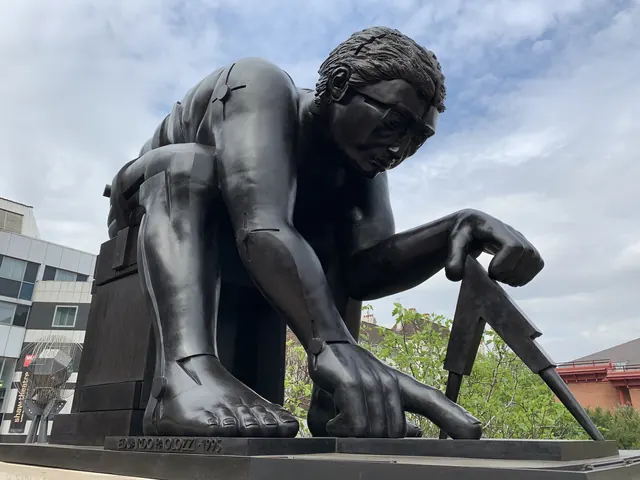
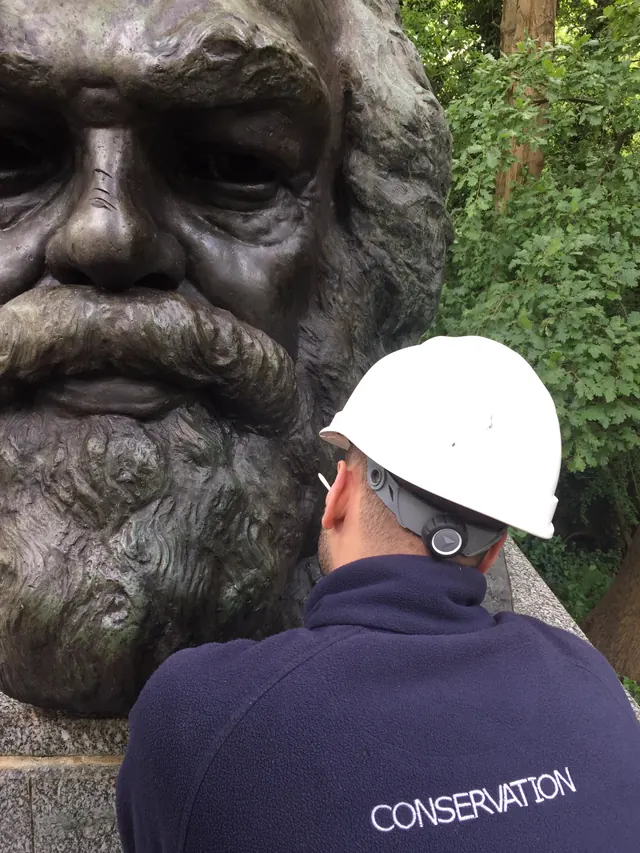
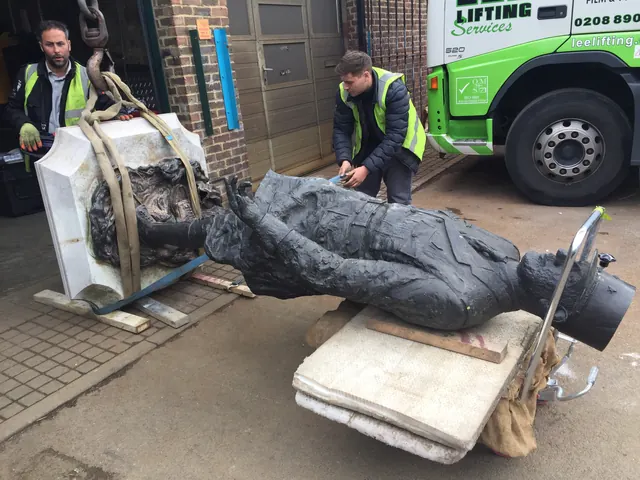
Outdoor bronze sculpture that Arts Heritage's website captions by subject (named statue or fountain). The photographs show surface appearance at the time they were taken.
Not evidence for
Corrosion mechanism, alloy, condition grade, treatment sequence or long-term outcome. None is published at source.
Status
Photographs and captions originally published by Arts Heritage at artsheritage.co.uk ↗. Mechanisms and treatments described in the guidance above are drawn from the cited literature, not proved by these images.
See all photographs in the Practice Archive →